
To make your site to be ranked on the first page of Google, On-Page SEO has to be mastered. On simple terms, on-page SEO is the process of optimizing single web pages in such a way that they are better understood by the search engines, and they are more useful to their users.
Being an experienced content writer and SEO strategist with more than 10 years of experience, I have assisted many websites in reaching the top of the search engine ranking through application of clever and user-centered on-page SEO methods. In this article, I will take you by the hand on the best ways to increase the visibility of your site in 2025.
What is On-Page SEO?
On-Page SEO (also known as on-site SEO) describes the optimization strategies that are implemented on your site. These involve bettering content quality, headings, meta tags, mobile-friendliness, site speed, etc. On-page SEO also provides full control, as opposed to off-page SEO where you are dependent on the backlink and external signal.
When it is well done, it informs Google what your page entails and why it needs to be ranked higher than your competitors.
Why On-Page SEO is Important in 2025
User-Centric Search Engine Algorithms Google has changed its search engine algorithms to emphasize user-centric content, Core Web Vitals, and semantic search.
Increased User Interaction -When the page is optimized, it becomes easier to read, loads quicker, and holds users more.
Increase the Organic Rankings- On-page factors enable Google to pair your page with the appropriate queries.
Improved Conversions- When your users can quickly find what they need, there is more possibility of conversion.
Key On-Page SEO Elements to Master
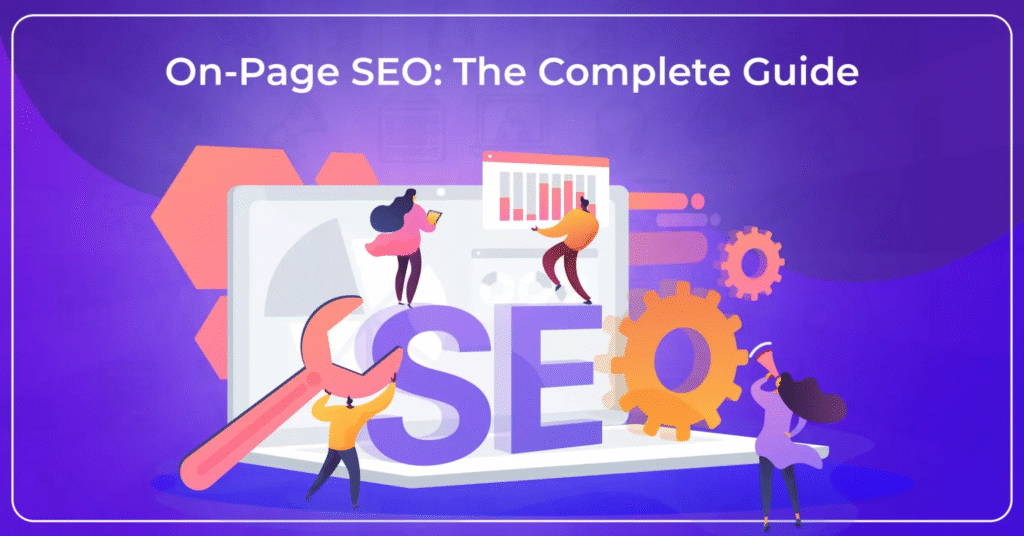
1. Title Tags
- Keep titles under 60 characters.
- Use the primary keyword at the start.
- Example: On-Page SEO Guide for Beginners in 2025
2. Meta Descriptions
- Write compelling summaries under 155 characters.
- Add your primary keyword naturally.
- Example: On-Page SEO techniques for ranking higher in 2025 with better content, optimized keywords, and faster site speed.
3. Clean URL Structure
- Keep URLs short, descriptive, and keyword-rich.
- Example: yoursite.com/on-page-seo-tips
4. Content Optimization
- Write unique, valuable, and user-focused content.
- Place the main keyword in the first 100 words.
- Use semantic keywords (LSI keywords) to cover related topics naturally.
5. Proper Heading Structure (H1, H2, H3)
- Use H1 for the main title (with keyword).
- Use H2 and H3 for subtopics and related points.
- This improves readability and SEO.
6. Internal and External Linking
- Link to other pages on your site to improve navigation.
- Add external links to trusted sources for credibility.
7. Image Optimization
- Use descriptive alt tags with keywords.
- Compress images for faster loading speed.
- Example: “on-page-seo-checklist-2025.jpg”
8. Mobile Friendliness
- Ensure your website is fully responsive.
- Mobile-first indexing means Google ranks mobile-friendly sites higher.
9. Page Loading Speed
- Optimize CSS, scripts, and images.
- Use tools like Google PageSpeed Insights or GTmetrix.
10. Schema Markup
- Add structured data (like FAQ schema, product schema) to help Google display rich snippets.
On-Page SEO Checklist for 2025
Here’s a quick checklist to follow before publishing a page:
- ✅ Primary keyword in title, meta description, and first paragraph
- ✅ Optimized headings (H1–H3)
- ✅ Internal & external links added
- ✅ Short, keyword-rich URL
- ✅ Images optimized with alt tags
- ✅ Page speed optimized
- ✅ Mobile-friendly design
- ✅ Schema markup where relevant
Common On-Page SEO Mistakes to Avoid
- Keyword Stuffing – Overusing keywords can hurt rankings.
- Duplicate Content – Google penalizes copied content.
- Ignoring User Intent – Content must match search intent.
- Poor Mobile Experience – A non-responsive site will lose traffic.
- Slow Load Times – Users leave if a page takes more than 3 seconds.
Future of On-Page SEO
In 2025 and beyond, Google is prioritizing E-E-A-T (Experience, Expertise, Authoritativeness, Trustworthiness). This means your content should not only be keyword-optimized but also provide real value to readers. Voice search optimization, natural language queries, and AI-driven search will also play bigger roles.
Conclusion
On-Page SEO is the foundation of a successful digital marketing strategy. By optimizing your titles, meta descriptions, content, internal links, and speed, you create a website that both Google and users love.
Remember, SEO isn’t about tricking search engines—it’s about creating a better online experience. Apply these strategies consistently, and you’ll see your site rise in rankings, attract more traffic, and convert more leads.🚀 Start optimizing today—because On-Page SEO is your key to dominating search results in 2025.
One Page SEO FAQs
Q1. What is One Page SEO?
One Page SEO refers to all the optimization techniques you apply directly on a single webpage—like meta tags, keywords, headings, images, and content—to improve rankings in search engines.
Q2. Why is One Page SEO important?
It helps search engines understand your content better, improves user experience, boosts rankings, and increases organic traffic.
Q3. What are the main elements of One Page SEO?
The key elements include optimized titles, meta descriptions, clean URLs, keyword placement, internal linking, image optimization, mobile-friendliness, and page speed
Q4. How do I optimize content for One Page SEO?
Use the primary keyword naturally in your title, headings, and first 100 words. Write user-focused, high-quality content, and include internal/external links.
Q5. Does One Page SEO guarantee first-page ranking?
No SEO technique guarantees instant first-page ranking, but strong One Page SEO significantly improves your chances by making your content more relevant and search-friendly.